
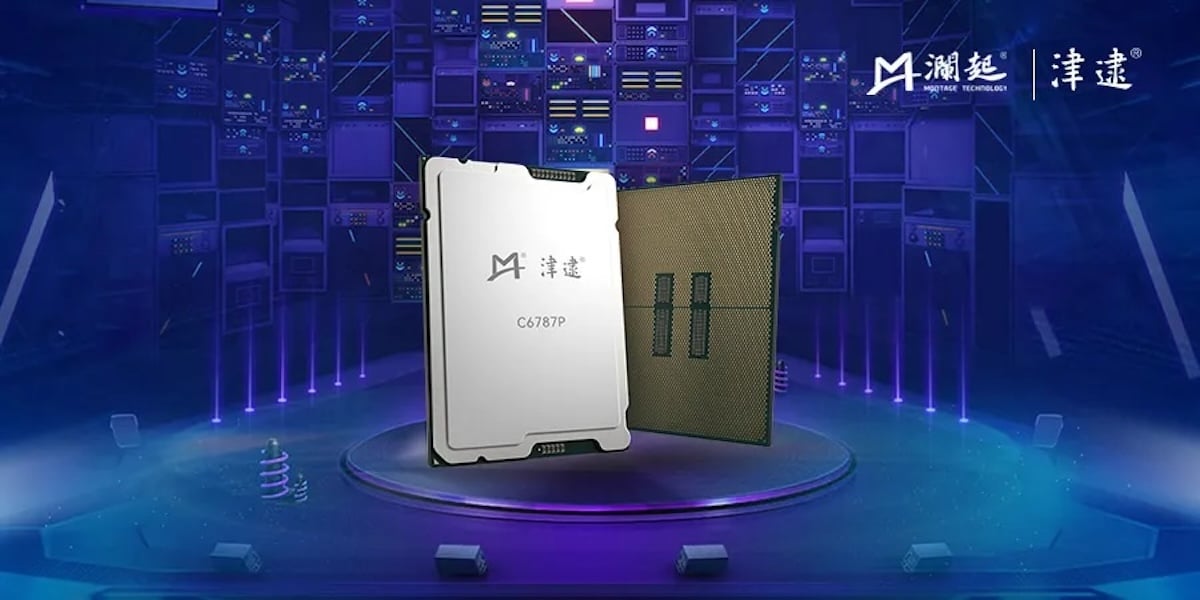
The ongoing technological war between the United States and China has taken a new turn in the semiconductor sector. Montage Technology, a Chinese fabless chip design firm, has unveiled its latest processors, the Jintide C6P series. These processors are built upon the Intel Xeon 6P Granite Rapids architecture but are customized with additional security and control features tailored specifically for the Chinese market.
This move affirms Beijing’s strategy to bolster its technological sovereignty in critical areas such as data centers, artificial intelligence, cloud computing, and government infrastructure.
A special agreement with Intel underpins the development of Jintide chips. The origins trace back to 2016 when Montage signed a partnership with Intel and Tsinghua University. This agreement allows the Chinese company to reconfigure Xeon processors with security functionalities and sell them domestically.
The fifth generation of these processors, based on Xeon Emerald Rapids, was introduced two years ago. Now, with the sixth generation, Montage is leveraging the Granite Rapids platform, which underpins current Intel Xeon 6700 and 6500 series.
The new Jintide C6P uses the same technical foundation as the Xeon 6787P, a processor boasting up to 86 cores and 172 threads, along with 336 MB of L3 cache.
Notable features include support for single or dual socket configurations (2S), DDR5 memory and latest-generation MRDIMM memory with speeds up to 8,000 MT/s, 88 PCIe 5.0 lanes compatible with CXL 2.0 for high-speed connections to GPUs, FPGAs, and AI accelerators, and an 8-channel memory subsystem designed for demanding workloads like AI training and large-scale data analysis.
One of the most significant distinctions from Western Xeon chips is the security layer integrated into Jintide C6P. These processors include proprietary encryption and decryption algorithms, along with platform trust measurement functions that add hardware-level controls to prevent data leaks and malicious manipulations. Montage states that these features are aimed at enabling critical sectors—such as banking, healthcare, and public administration—to meet China’s strict privacy and security regulations.
The emergence of Jintide C6P symbolizes China’s efforts to reduce dependency on foreign chips and gain tighter control over its digital infrastructure. Meanwhile, in the West, the existence of these customized models raises concerns about state-backed hardware security, especially given their high-performance capabilities for AI clusters and cloud services, coupled with embedded surveillance features that fuel debates on cybersecurity and digital rights.
Montage’s approach extends beyond hardware. The company collaborates closely with open-source software communities like openEuler, OpenAnolis, and OpenCloudOS in China to ensure compatibility with their chips. They have also achieved certifications with local cloud providers and database services, facilitating adoption in strategic sectors.
Stephen Tai, president of Montage Technology, summarized the company’s vision: “The launch of the C6P represents a dual advance: increased computational power and enhanced chip-level security. Our goal is to provide a competitive option that supports the digital transformation of critical sectors in China.”
Frequently Asked Questions (FAQ)
What are Jintide processors?
They are CPUs based on the Intel Xeon architecture, adapted by Montage Technology for the Chinese market, incorporating additional security and encryption features.How do they differ from original Intel Xeons?
They share the same base architecture (Granite Rapids) but include specific modules for data protection and surveillance, aligned with Chinese government requirements.Who are they intended for?
They target data centers, government institutions, banking, healthcare, and sectors where security and digital sovereignty are priorities.What impact do they have on US-China rivalry?
They reinforce China’s technological independence and introduce a new front in the global competition over semiconductors and AI infrastructure.
