
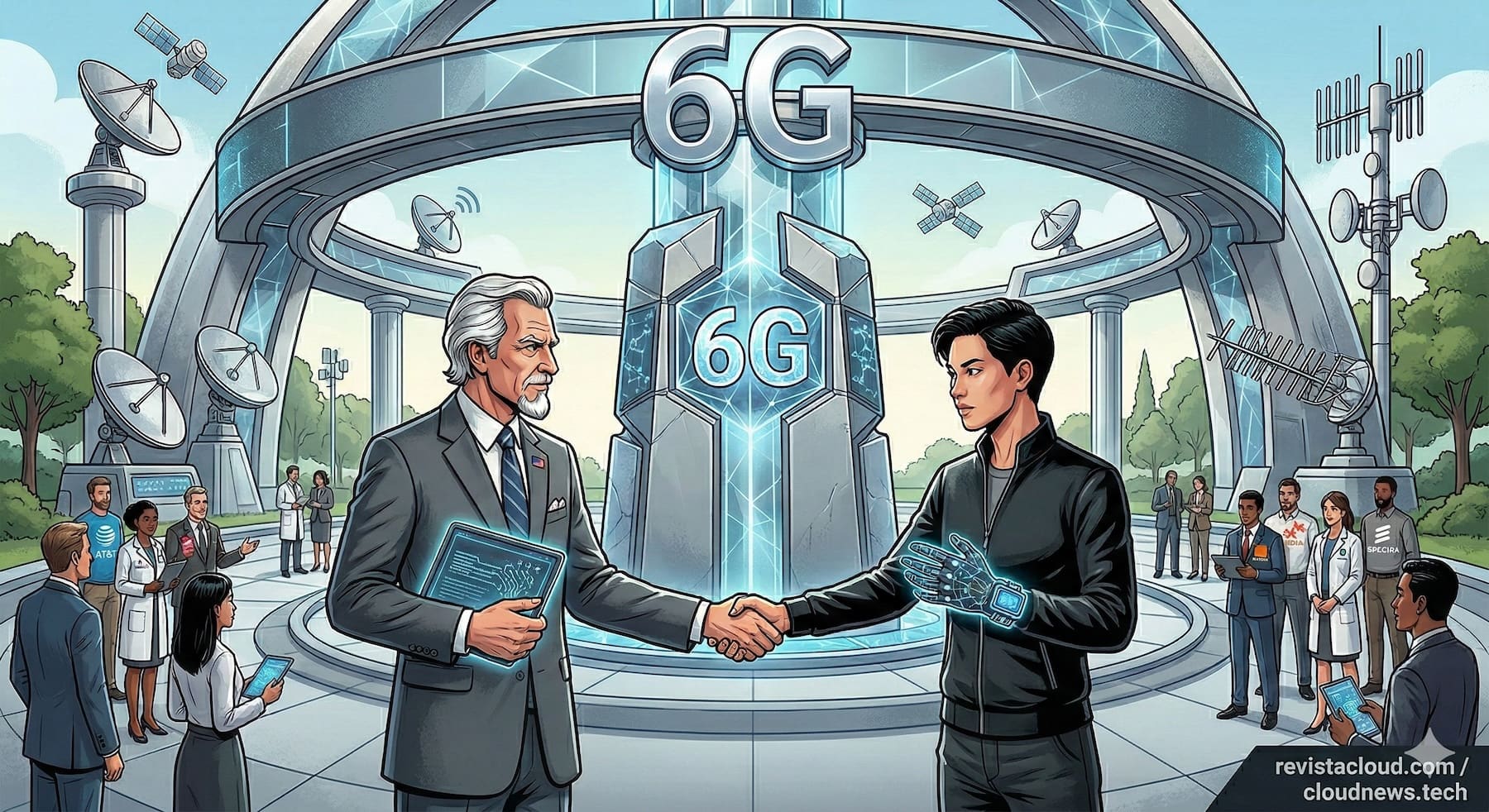
The next generation of mobile networks is beginning to take shape long before a single compatible device exists. And, according to the roadmap being outlined for 2026, 6G doesn’t want to be just “faster” than 5G: it aims to emerge as an AI-native platform, with Artificial Intelligence embedded into the network’s design from day one.
This is the message NVIDIA conveyed at the Mobile World Congress (MWC) when announcing a joint commitment with a broad group of operators and infrastructure providers to build future connectivity on open, secure, reliable, and software-defined platforms. Participants mentioned by the company include Booz Allen, BT Group, Cisco, Deutsche Telekom, Ericsson, MITRE, Nokia, ODC, SK Telecom, SoftBank Corp., T-Mobile, and the OCUDU Ecosystem Foundation.
The concept is simple to understand: if the next mobile network is going to support an economy of autonomous machines, sensors, and critical systems, then the network must “think”, not just transport data.
From connectivity network to “fabric” for physical Artificial Intelligence
In its statement, NVIDIA frames 6G as the “fabric” over which the so-called Physical Artificial Intelligence will operate: vehicles, robots, sensors, and machines acting in the physical world, at large scale. This leap, the company argues, significantly increases demands for security and trust, exposing a limitation: traditional wireless architectures were not designed for that level of complexity and autonomy.
The coalition’s proposed answer is to develop 6G as a software-defined and AI-native network. That is, a network capable of evolving as quickly as its software, integrating intelligence from the radio (RAN) to edge and core, with real-time decision-making capabilities.
According to Jensen Huang, founder and CEO of NVIDIA, Artificial Intelligence is redefining computing, and telecom will be “the next”. His thesis is straightforward: with an AI-RAN-based architecture, mobile networks can become infrastructure for Artificial Intelligence everywhere.
What does “AI-native” mean for a 6G network?
The term might sound like marketing jargon, but in the context of the network, it implies a fundamental transformation. NVIDIA describes a 6G where Artificial Intelligence is embedded in the daily operation of the infrastructure:
- Real-time network decisions: dynamic resource allocation, performance optimization, demand adaptation, and continuous automatic adjustments.
- Integrated security and trust: increased focus on system integrity, resilience, and continuous verification—not as add-on layers.
- Continuous software evolution: instead of long hardware renewal cycles, the network could “improve” through new versions and programmable capabilities.
- Sensing + communications: the statement mentions networks enabling integrated communications with “sensing” (detection) capabilities securely, a component associated with 6G in industrial discussions.
The key is that Artificial Intelligence ceases to be just auxiliary tools (e.g., for analytics or specific optimization) and becomes part of the operational brain of the network.
Openness & trust: openness as a strategic weapon
NVIDIA emphasizes that 6G infrastructure must be open and programmable to accelerate innovation and reduce dependencies. The announcement presents 6G as an ecosystem where from major operators and manufacturers to startups, researchers, and developers, all participate on a common “trustworthy” platform.
This “openness” aligns with a sector reality: telcos increasingly seek interoperability and supply chain resilience, in a context where network infrastructure has become a geopolitical asset. The more components and software from multiple players can be integrated, the less vulnerable operators are to technological blockades or over-reliance on a single vendor.
Telcos: “connectivity as the backbone” of the economy
The statements from partners reflect that the aim is not only technical but also economic. Allison Kirkby, CEO of BT Group, describes connectivity as the “growth backbone” and emphasizes that building on open and trustworthy platforms would help 6G leverage 5G’s strengths and unlock new scale capabilities.
Tim Höttges, CEO of Deutsche Telekom, frames it from a business perspective: “better network, better experience” as a promise, with 6G as the foundation for the era of physical Artificial Intelligence and new services for industry and society.
From the US side, Arielle Roth (NTIA) links leadership in 6G to economic prosperity, national security, and global competitiveness, presenting the coalition as a bloc of allies and partners aiming to shape the next-generation mobile landscape.
AI-RAN, AI-WIN, and OCUDU: pieces already in motion
The statement also makes it clear that this isn’t starting from scratch. NVIDIA positions the initiative within a web of public and private programs:
- Participation in the OCUDU initiative led by the FutureG Office in the United States.
- Founding member of the AI-RAN Alliance, which, according to NVIDIA, already has more than 130 companies involved.
- Launch of the AI-WIN project in October, described as an AI-RAN stack “all-American,” alongside Booz Allen, Cisco, T-Mobile, MITRE, and ODC.
- Collaborations with consortia and governments across Korea, the UK, Europe, and Japan to advance programmable and reliable networks.
The market takeaway is clear: the “race” for 6G will not be decided solely in labs or standardization forums but also by who manages to create the first real deployment ecosystem.
NVIDIA’s incentive: turning the network into accelerated computing infrastructure
Strategically, the move also benefits NVIDIA. If 6G networks evolve into software-defined platforms with embedded AI and acceleration at the edge and core, part of the value flows from connectivity to computing. NVIDIA’s strengths in GPUs, acceleration, programmable platforms, and software ecosystems position it advantageously.
For telcos, potential benefits include a network that is more efficient (energy, capacity, maintenance), more resilient, and—crucially—capable of enabling new services—from automated industries to autonomous systems, where latency, security, and reliability are paramount.
While 6G is still far from commercial deployment, its standards are being shaped well in advance of user devices. The MWC announcement underscores a key takeaway: crucial decisions about future architecture are being made now, with Artificial Intelligence at the core of the design—not just as an add-on.
Frequently Asked Questions
What does it mean for 6G to be “AI-native”?
It means integrating Artificial Intelligence into the network architecture from the outset (radio, edge, and core), to operate and optimize the network continuously, not as an afterthought layer.
Which companies participate in NVIDIA’s announced alliance?
Among others, NVIDIA mentions BT Group, Deutsche Telekom, T-Mobile, SoftBank, Ericsson, Nokia, Cisco, SK Telecom, Booz Allen, MITRE, ODC, and the OCUDU Ecosystem Foundation.
What is AI-RAN and why is it important for 6G?
It refers to the “Radio Access Network” approach with integrated Artificial Intelligence, aimed at programmable, software-defined networks that evolve faster and support new applications at scale.
When will 6G reach end users?
While no exact date is given, the commercial deployment of 6G is generally expected in the next decade; the key is that its architecture and ecosystems are being defined years in advance.
via: nvidianews.nvidia