
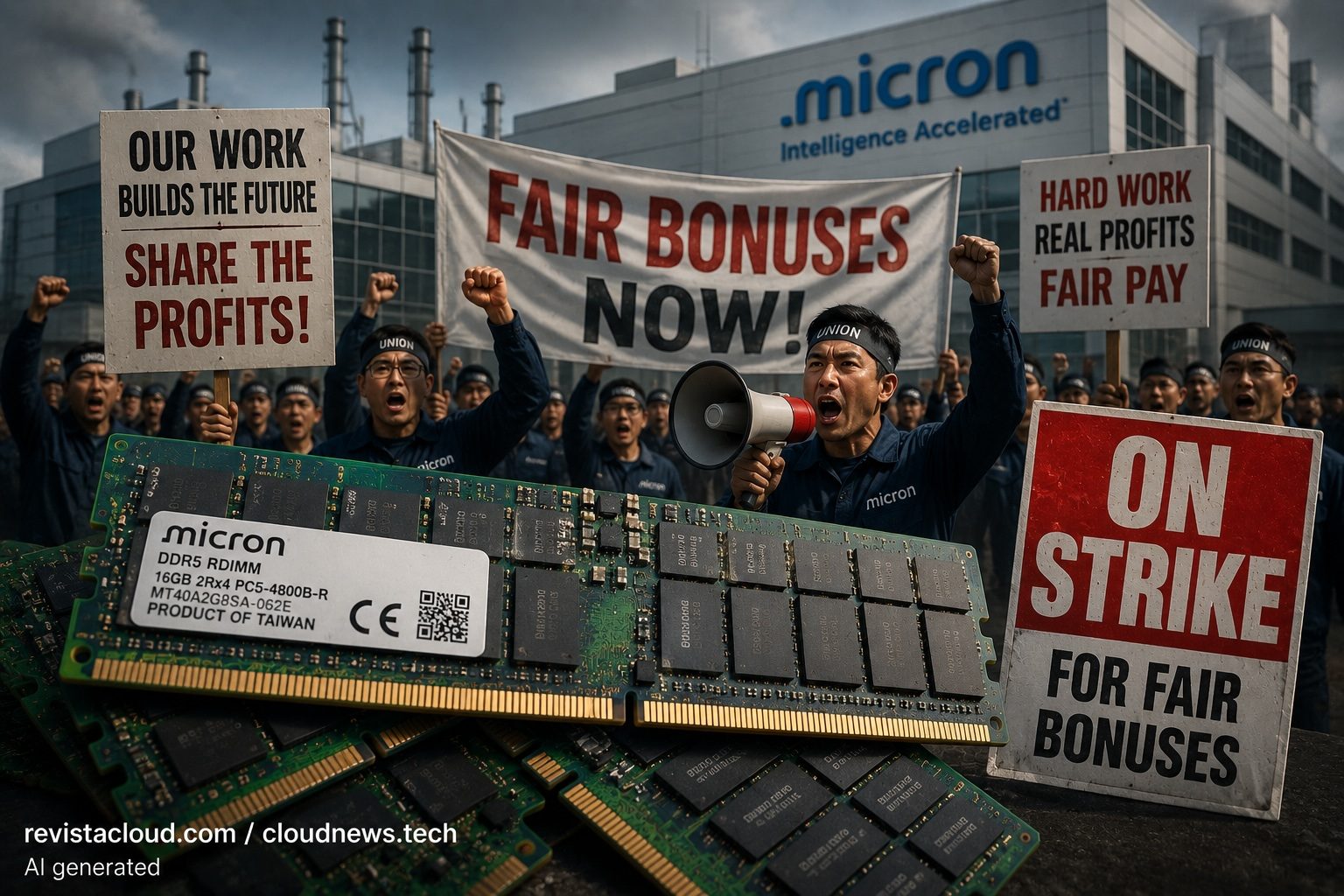
Micron Technology is facing a labor dispute in Taiwan at a particularly sensitive moment for the global memory market. The two unions representing workers at its Taoyuan and Taichung facilities, with close to 10,000 members out of a combined workforce of roughly 15,000, are moving toward a possible strike unless the company changes its bonus system and offers a bigger share of profits.
The Micron labor dispute in 20 seconds
- The two unions represent close to 10,000 Micron employees in Taiwan.
- More than 80% of those who took part in an internal poll backed turning to a strike.
- They want to replace the current incentive system with one more closely tied to profits.
- Micron says the 2026 bonus will be the largest in its history.
- The dispute coincides with exceptional demand for DRAM and HBM tied to AI.
There is no strike called yet, and it can’t be assumed one will happen. The dispute is still at an early stage, and Taiwan’s labor framework includes mediation procedures before it can reach a formal vote.
The union pressure, however, comes after an extraordinarily strong stretch for Micron’s business. The company closed its third fiscal quarter of 2026, which ended May 28, with $41.46 billion in revenue and $28.24 billion in GAAP net income, both record levels.
Artificial intelligence is behind much of that shift. The new accelerators need growing amounts of high-bandwidth memory (HBM), while AI servers are also driving up consumption of conventional DRAM and storage.
Workers Want the Profits to Show Up in Their Bonuses Too
The standoff isn’t mainly about base pay. The unions are challenging how Micron calculates the incentives its workers receive.
The company uses an Incentive Pay Plan (IPP) that ties compensation to various business metrics. Union representatives argue the system doesn’t adequately reflect the sharp rise in profits generated during the current memory cycle.
Micron, for its part, maintains that performance-based compensation for this fiscal year will be the largest the company has ever paid and says it will keep negotiating through established channels.
The disagreement, then, is over both the amount and the model used to calculate it.
According to information shared by the unions, they are pushing for an extraordinary payment for fiscal year 2026 and, starting in 2027, want to move toward a system in which 15% of profit is distributed to employees every quarter.
The demands take their cue from what has recently happened in South Korea, where workers at the major memory makers have also pushed for compensation systems more closely tied to the results of their semiconductor divisions.
Samsung reached an agreement this year that averted a strike and set up a bonus mechanism tied to the operating profit of its chip business. SK hynix likewise has systems in which business results carry significant weight in compensation.
Taiwan’s unions believe that trend is widening the gap between workers doing similar jobs within a global industry.
Internal support for taking action appears considerable. More than 80% of workers who took part in an online survey run in August backed the possibility of a strike if negotiations fail to produce an agreement.
That figure needs to be read correctly: it represents those who took part in the poll, not necessarily 80% of Micron’s entire Taiwan workforce.
The Dispute Lands as AI Memory Sets Records
The timing chosen by the unions raises the stakes of the dispute.
Micron is going through one of the strongest financial stretches in its history. Third-fiscal-quarter revenue jumped from $9.3 billion a year earlier to $41.46 billion, while GAAP net income reached $28.24 billion.
The company attributes this growth to AI-related memory demand and constrained supply.
Micron has also accelerated its push into HBM. Its 36 GB, 12-layer HBM4 entered high-volume production in the first quarter of 2026 and was designed for platforms like NVIDIA Vera Rubin. The company says it delivers more than 2.8 TB/s of bandwidth per device.
Taiwan occupies an important place in that strategy.
In March, Micron completed its acquisition of Powerchip Semiconductor Manufacturing Corporation’s (PSMC) P5 plant in Tongluo. The facility has roughly 300,000 square feet, about 27,900 square meters, of cleanroom space for 300 mm wafers and will be integrated with Micron’s existing operations in Taichung.
The company explained that the expansion will help increase supply of advanced DRAM, including HBM, specifically to meet growing AI-driven demand.
That’s why a labor dispute in Taiwan would carry a dimension that goes beyond Micron’s internal relations.
A sufficiently broad and prolonged strike could affect production, but it’s still too early to quantify any impact on the global memory supply. There’s no factory shutdown at this point, and it also can’t be assumed that a potential strike would affect every production line equally.
Semiconductor manufacturing also has its own quirks compared with other industries. Fabs run on continuous, highly automated processes, so the impact would depend on which workers took part, how long a protest lasted, and how Micron organized operations.
A Negotiation the AI Industry Will Be Watching Closely
The dispute also comes as Micron keeps expanding capacity outside Taiwan.
The company has raised its planned investment in manufacturing and R&D in the United States to more than $250 billion through 2035. Its long-term goal is to produce around 40% of its DRAM there.
That doesn’t reduce the short-term importance of its Asian fabs.
Building new semiconductor plants takes years and billions of dollars. The capacity that currently supplies the market remains necessary while manufacturers try to keep up with rapidly rising memory consumption.
Micron acknowledges that both conventional and AI-focused servers are currently constrained by insufficient DRAM and NAND availability.
That’s why any production disruption would be closely watched by server makers, accelerator designers, and data center operators.
But presenting an immediate price increase as an inevitable consequence would be premature. The outcome would depend on how long any strike lasted, available inventories, capacity at other plants, and the behavior of Samsung and SK hynix, among other factors.
For now, this remains a labor negotiation, not a production disruption.
The unions have also found a moment when their bargaining power is greater. Micron is posting record profits, demand remains elevated, and HBM has become an essential component for AI systems.
The company also has an incentive to keep the dispute from escalating. The question will be how far it’s willing to adjust its bonus model, and whether workers see a record 2026 payout as sufficient or hold firm on their demand to structurally change how profits are shared.
Frequently Asked Questions
Are Micron workers already on strike?
No. Taiwan’s unions are moving toward possible labor action, but there is no general strike underway yet. The relevant labor procedures still need to play out first.
How many workers could take part?
The two unions in Taoyuan and Taichung say they represent close to 10,000 employees out of a combined workforce of roughly 15,000.
What are Micron’s unions demanding?
They want to change the bonus system to tie it more directly to the company’s profits. Their proposals include moving toward a quarterly profit-sharing model starting in fiscal year 2027.
Could a strike affect the HBM and DRAM supply?
A sufficiently broad and prolonged stoppage could affect Micron’s production in Taiwan, an important location for its memory manufacturing. However, there is no strike yet, and no impact on the market can be quantified until its scope and duration are known.
