
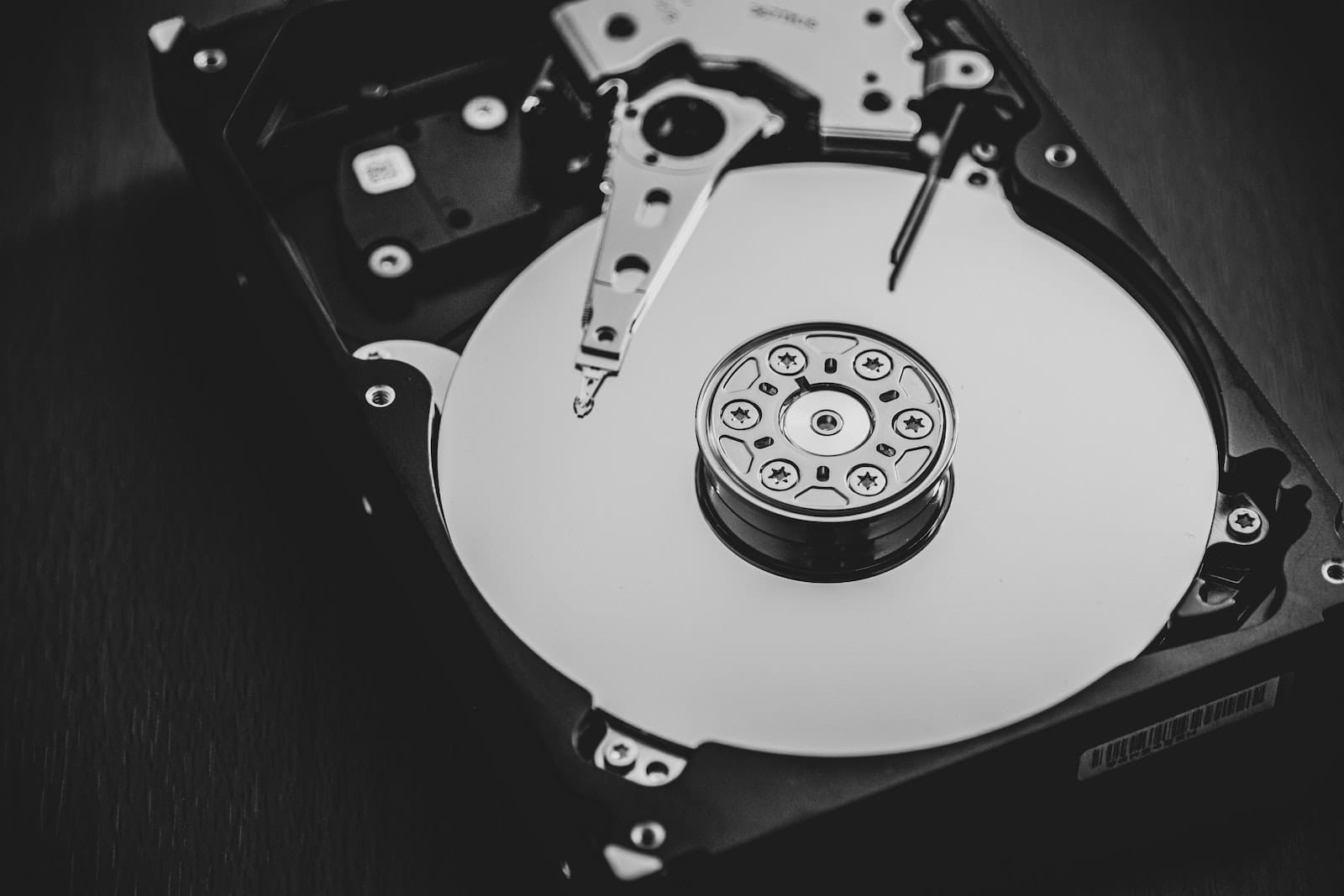
While the SSD has become the de facto standard for installing the operating system and demanding games, the mechanical hard drive (HDD) refuses to disappear. Indeed, it has shifted roles—from being the “main drive of the PC” to the center of silent mass storage in data centers, backups, and massive libraries. And it’s precisely this demand— fueled by the data explosion associated with Artificial Intelligence—that is driving a new capacity escalation that just a few years ago seemed science fiction: units of 100 TB around 2029.
Western Digital (WD) has set a timeline and roadmap for this jump. The company announced that its HDD UltraSMR ePMR 40 TB is in qualification phase with hyperscale clients, with volume production planned for the second half of 2026, alongside a transition to HAMR in 2027. In this same framework, WD outlines a “clear path” toward 100 TB or more by the end of the decade, targeting the milestone in 2029. The message is clear: this isn’t just a technological whim but a response to a market obsessed with reducing cost, energy, and complexity per terabyte.
How to reach 100 TB without magic (and why it’s not “a normal HDD”)
The secret isn’t a single breakthrough but the sum of several:
- Increased platter density and greater precision in writing/reading.
- New recording techniques (ePMR/SMR and later HAMR or equivalents depending on the manufacturer).
- Mechanical improvements to boost performance without multiplying power consumption, heat, or vibrations.
For example, WD is pushing the ePMR + UltraSMR tandem as a step before HAMR. In practice, this usually involves trade-offs: technologies like SMR (Shingled Magnetic Recording) help increase capacity but penalize certain write patterns (many small, random writes), which is exactly the type of activity that appears when a game is updated with huge patches, shaders are recompiled, or dozens of files are rewritten.
Meanwhile, manufacturers are also trying to make HDDs no longer synonymous with “slow” in sequential tasks. WD has introduced concepts like High Bandwidth Drive (wider bandwidth by adding actuators/readers) and designs like Dual Pivot with the aim of multiplying sustained performance for large-scale fleets. It’s no coincidence: with libraries of data in the hundreds of petabytes, every minute of deployment and every watt counts.
Not just WD: Seagate and Toshiba also in the game
The trend is industry-wide, not just from a single brand. Seagate has already showcased its HAMR commitment with the Mozaic 3+ platform, with units reaching up to 36 TB, and publicly maintains a roadmap aiming at 100 TB by 2030. Toshiba, on the other hand, has spoken of HDDs reaching 40 TB in 2027 using platter stacking and its MAMR approach, competing to stay in the capacity leap wave.
In summary: hard drives are evolving to survive in a world dominated by AI. The question is whether this future also makes sense in a home PC… specifically, in a gaming PC.
Table: HDD size and evolution (from current “limit” to a decade of 100 TB)
| Year | “Milestone” Capacity (approx.) | Short explanation |
|---|---|---|
| 2017 | 10 TB | Start of the era of large 3.5″ HDDs on a massive scale (helium, higher density). |
| 2024 | 32 TB | Density jumps and enterprise platform milestones (first major steps before 36 TB). |
| 2025 | 36 TB | HAMR in data center products (new capacity reference). |
| 2nd half 2026 | 40 TB | UltraSMR ePMR in volume production (serious “40 TB” on the market). |
| 2027 | 40 TB | 40 TB also via other technologies (HAMR/MAMR depending on manufacturer). |
| 2028 | 50 TB | Intermediate targets in HAMR roadmaps. |
| 2029 | 100 TB+ | Declared goal for next-generation, large-scale HDDs. |
| 2030 | 100 TB | Explicit roadmap objective in the sector. |
Key note: these figures refer to the data center market. Their existence doesn’t necessarily mean they’ll be cheap, silent, or ideal for a home PC.
Does a 100 TB HDD make sense for gamers?
For the average gamer, the quick answer is: not as a primary disk. Most modern titles load better—and sometimes need—SSD, and moving to NVMe is especially noticeable in open worlds, textures, and load times. An HDD—no matter how large—still has mechanical latency and poorer random access performance.
But the full answer has nuances. It can be worthwhile in specific profiles:
- Collectors of massive libraries who want to avoid endless downloads and keep their catalog “cold.” A massive HDD can serve as a storage for installs, captures, mods, and backups.
- Content creators accumulating hours of high-rate recordings (gameplay, streams, editing projects).
- Users with poor internet connection preferring to archive and move games between SSD and HDD depending on what they’re playing that month.
The problem is that the 100 TB HDD imagined by the market isn’t a “BarraCuda XXL Desktop.” It’s more likely to be a rack-oriented unit, with firmware and load profiles prioritizing reliability and efficiency at scale. And if it also involves aggressive SMR, it can become a pain in scenarios with constant random writes (updates, fragmented installs, caches).
“More than 100 TB,” at home and with smart planning: yes, it’s possible… before 2029
Here’s the irony: exceeding 100 TB doesn’t require a single 100 TB drive. There are more realistic pathways:
- NAS/home server with multiple large HDDs: with current high-end units (24–26 TB), a 6–8 bay case is enough to surpass 100 TB in raw capacity, with room for redundancy.
- JBOD and expansion enclosures: modeling after data center “small scale” setups—many disks, easy control and replacement.
- LTO tape for archival storage: for those truly wanting “forever” storage disconnected from the network, the new LTO-10 standard reaches 40 TB native per cartridge, and the standard mentions up to 100 TB with compression, focused on preservation and cyber-resilience.
In other words: the future of 100 TB per disk exists, but the “more than 100 TB” is already attainable today through architecture, not just in a single piece.
Frequently Asked Questions
Would a 100 TB hard drive work for installing and playing directly like an SSD?
It could be installed, but it wouldn’t be ideal. Latency and random access performance remain the Achilles’ heel of HDDs, and in modern games, this translates into longer load times, stuttering during data streaming, and a worse overall experience.
What practical differences are there between CMR and SMR when used in a game library?
CMR generally performs better with random writes and mixed loads. SMR can do well in sequential read/write tasks but may suffer when many small rewrites occur (patches, checks, reinstalled files), which is common with current games.
Is it worth setting up a NAS over 100 TB for gaming?
It makes sense as a “storage” (libraries, captures, mods, backups) but not as a replacement for an internal SSD for playing. The most balanced approach usually combines SSD/NVMe for active gaming and NAS/HDD for archiving and rotation.
Is LTO tape a real alternative for advanced users?
Yes, for long-term archiving and backups. It isn’t practical for daily use but offers a competitive cost-per-terabyte at large scale and is particularly useful if you prioritize offline storage (air gap).